What age is a pogo stick good for? Ultimate guide 2026
What age is a pogo stick good for? The Ultimate Guide to Developmental Readiness, Weight Thresholds, and the Complete Pogo Lifecycle
You stand in a garage, a toy store aisle, or browse an online marketplace, eyeing a sleek, metallic spring-loaded contraption, and a wave of pure nostalgia washes over you. You remember the rhythmic sproing-sproing-sproing echoing down the suburban sidewalks of your youth, the thrill of defying gravity for a fraction of a second, and the intense physical challenge of keeping your balance on a single metal rod.
Now, you are looking to pass that iconic experience down to the next generation—whether that means your energetic 5-year-old bouncing off the living room walls, a tech-fatigued 10-year-old who needs a reason to step outside, or a thrill-seeking teenager looking to master extreme action sports.
But as you reach for the handle, a critical, safety-minded question halts your momentum: What age is a pogo stick good for?
Is it safe for a kindergartener whose motor skills are still developing? Is it too childish for a middle schooler? Will a standard model snap under the weight of a growing teenager, or conversely, will a child be too light to compress the heavy steel spring at all?
The answers to these questions are far more complex than a simple age bracket stamped onto a cardboard box by a manufacturer. Deciding when to introduce a pogo stick involves a careful matrix of physical development, weight limitations, cognitive coordination, and choosing the exact right engineering type for the rider’s body.
+-------------------------------------------------------------+
|              THE POGO STICK READINESS MATRIX                |
+-------------------------------------------------------------+
| 1. BIOLOGICAL DEVELOPMENT:                                  |
|    - Vestibular system maturation (inner ear balance).       |
|    - Core muscular stability and ankle tracking.            |
|                                                             |
| 2. TECHNICAL ENGINEERING MATRICES:                         |
|    - Spring compression thresholds vs. rider weight.        |
|    - Foam vs. metal construction vs. air-pneumatic power.   |
|                                                             |
| 3. SAFETY & URBAN GEOGRAPHY:                                |
|    - Smooth concrete surfaces vs. urban environments.       |
|    - Proper protective gear blueprints (HELMETS FIRST!).     |
|                                                             |
| 4. THE BESTPOGOSTICK.COM DEFINITIVE OUTPUT:                 |
|    - A safe, progressive roadmap spanning ages 3 to 93.      |
+-------------------------------------------------------------+
When you dig into the core details of pogo stick safety and ergonomics, you discover a deeply rewarding world of childhood development and physical biomechanics. Pogo sticking isn’t just a retro pastime; it is an exceptional, high-intensity workout that builds incredible core strength, sharpens spatial awareness, improves vestibular balance, and builds mental resilience through step-by-step skill mastery.
From the high-density residential sidewalks of Brooklyn and Manhattan, the expansive suburban driveways of Texas and Florida, to the active, health-conscious beach boardwalks of Miami, San Francisco, and southern California, matching the perfect pogo stick to the right age and weight category is the ultimate secret to unlocking a lifetime of safe, active fun.
This comprehensive, highly detailed master guide for bestpogostick.com delivers an exhaustive exploration of the exact age brackets, developmental signs, weight requirements, and product engineering styles needed to answer the question once and for all. We will explore the neurobiology of balance, break down childhood milestones, examine specific age tiers from toddlers to adults, analyze the critical differences between spring and air-powered pogo sticks, and give you an actionable buying blueprint to make sure your investment brings high bounces and zero injuries.
1. The Biomechanics and Developmental Neurobiology of Bouncing: What age is a pogo stick good for
To truly understand when a child is ready to step onto a traditional metal pogo stick, we must first look at the neurobiology of human balance and the physical mechanics of vertical impact.
The Vestibular System and Dynamic Equilibrium
Maintaining your balance on a pogo stick is an incredible feat of neurological coordination. It requires the perfect integration of three primary systems: the vestibular system (the fluid-filled semicircular canals in the inner ear that detect motion and orientation), the visual system (tracking the horizon to maintain vertical alignment), and the proprioceptive system (receptors in the joints and muscles that tell the brain where the body is in space).
                     [ THE BALANCE INTEGRATION ENGINE ]
                                     │
          +──────────────────────────┴──────────────────────────+
          │                                                     │
          ▼                                                     ▼
    [ VESTIBULAR SYSTEM ]                             [ PROPRIOCEPTIVE NETWORK ]
- Located in the inner ear canals.                   - Nerve receptors in joints & muscles.
- Detects vertical acceleration and tilt.            - Signals microscopic ankle adjustments.
- Matures fully between ages 5 and 7.                - Dictates real-time core stabilization.
In early childhood, these systems are still developing. The inner ear’s ability to process rapid up-and-down motion while making microscopic muscle adjustments matures significantly between ages 5 and 7. Before this window, a child’s brain cannot easily process the rapid sensory feedback of a high-speed rebound.
Introducing a traditional mechanical spring pogo stick before these systems are fully connected often results in immediate tipping, frustration, and unnecessary falls.
The Biomechanical Impact: Why Weight Matters Far More Than Age
The most common mistake parents make when buying a pogo stick is looking only at the age recommendation on the box while ignoring the weight threshold.
Every classic pogo stick is engineered around a central steel coil spring. Springs do not care about birth certificates; they only care about gravity and mass.
- The Problem of Being Too Light: If an 8-year-old child weighs only 45 pounds, but steps onto a standard youth pogo stick designed for kids weighing 60 to 110 pounds, their body weight will not be heavy enough to compress the spring. When they jump, the stick behaves like a stiff, unyielding metal stilt. The impact energy travels straight up through their knees and spine, causing an uncomfortable jar that knocks them off balance.
- The Danger of Being Too Heavy: Conversely, if a fast-growing 11-year-old weighing 120 pounds bottoms out a spring rated for a maximum of 100 pounds, the coil completely squishes down on the very first bounce. With the spring fully compressed, the safety buffer disappears, causing a harsh, metal-on-metal stop that can launch the rider forward over the handle bars.
Therefore, our guiding golden rule at bestpogostick.com is: Age determines a rider’s cognitive coordination and safety awareness, but weight dictates the physical engineering of the pogo stick.
2. The Complete Pogo Lifecycle: Detailed Age-by-Age Breakdown
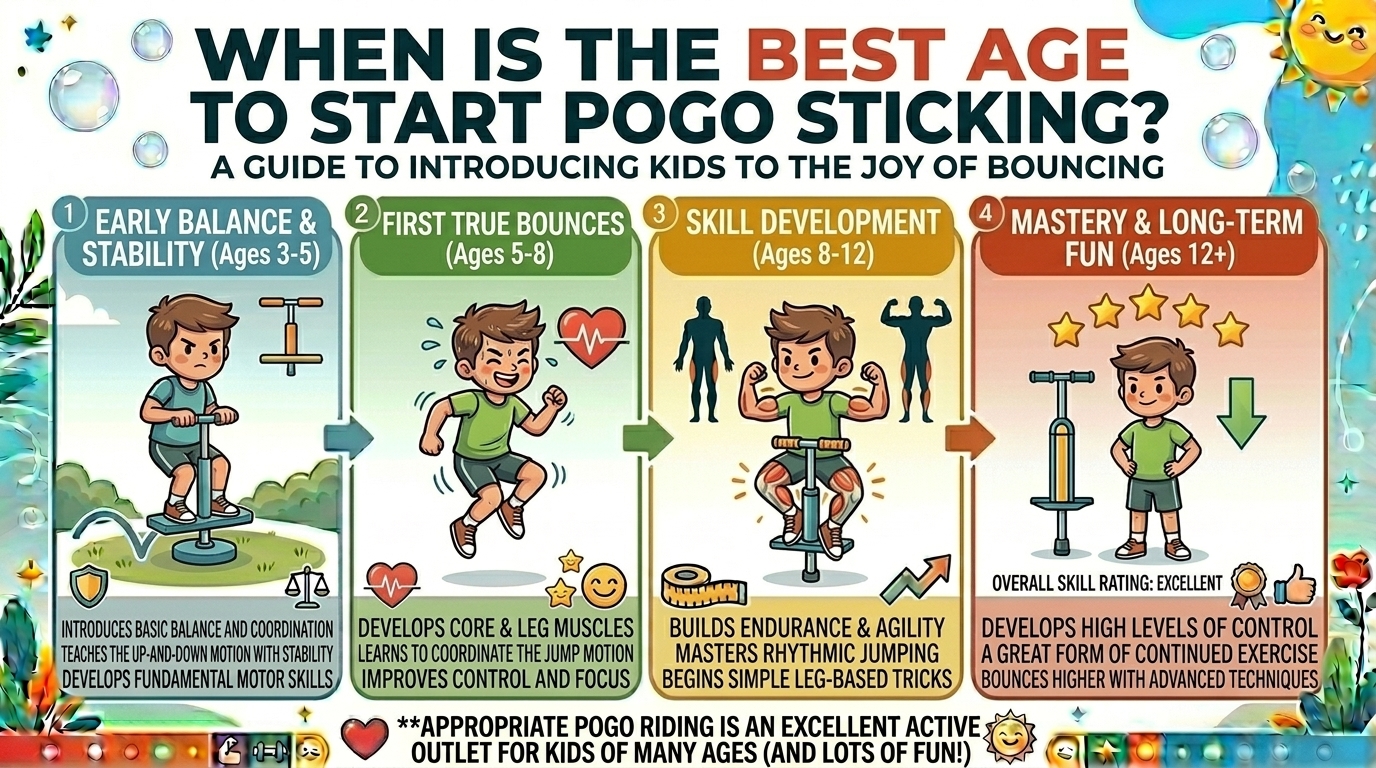
Let’s break down the developmental milestones, readiness signs, and exact equipment recommendations across five distinct age tiers to help you find the absolute perfect match for your family.
+-----------------------------------------------------------------------+
|                    THE POGO STICK EQUIPMENT MATRIX                    |
+-----------------------------------------------------------------------+
| AGE GROUP:        | REQUISITE WEIGHT:  | RECOMMENDED POGO TYPE:        |
|───────────────────┼────────────────────┼───────────────────────────────|
| Toddlers (3-5)    | 25 - 50 lbs        | Foam Pogo Jumper / Squeaker   |
| Early Youth (5-8) | 40 - 80 lbs        | Soft-Spring Starter (My First)|
| Mid-Youth (9-12)  | 60 - 110 lbs       | Heavy-Duty Metal Core Master  |
| Teens & Techs     | 80 - 160 lbs       | Advanced Intermediate Spring  |
| Extreme Adults    | 100 - 250+ lbs     | Pneumatic Air-Power Monster   |
+-----------------------------------------------------------------------+

Tier 1: The Toddler and Preschool Years (Ages 3 to 5)
At this delightful stage, children are rapidly refining their gross motor skills. They are learning to hop on one foot, kick a ball, and jump off low curbs. However, their ankles are highly flexible, their core stability is minimal, and their heads are proportionally larger relative to their bodies, which changes their center of gravity.
Are they ready for a real pogo stick?
No. A traditional metal spring pogo stick is an absolute safety hazard for a child under 5 years old. They lack the ankle strength and fast reflexes needed to keep a single vertical rod balanced.
The Perfect Alternative: The Foam Pogo Jumper
For this age bracket, the industry developed the incredibly popular Foam Pogo Jumper (often made of durable, soft block foam with an elastic stretchy cord handle).
- Why it works: This product replaces the stiff metal rod with a wide, flat foam base that sits completely flat on the ground. The child stands on the block and pulls up on the stretchy handle, jumping across the floor like a bunny.
- Developmental Benefits: It is 100% safe for indoor use on hardwood floors or carpets in New York apartments or spacious Texas living rooms. It creates a fun, built-in squeaker sound that rewards every successful hop, teaching children the basic rhythm of jumping, building core abdominal muscles, and sharpening their balance without any risk of a hard metal fall.
Tier 2: The Early Youth Group (Ages 5 to 8)
This is the golden window where the magical world of real pogo sticking officially begins. By age 6 or 7, a child’s inner ear vestibular system is fully online, their reaction times are significantly sharper, and they can easily understand multi-step safety rules (like keeping a helmet on and staying away from traffic or stairs).
Signs of Physical Readiness:
- The child can easily jump up and down on a flat sidewalk 20 times in a row without falling over or losing their balance.
- They can balance steady on one foot for at least 5 to 10 seconds.
- Their physical weight has reached at least 40 to 45 pounds, which is the minimum mass required to compress a lightweight, beginner-level steel spring.
+-------------------------------------------------------------+
|              THE EARLY YOUTH PROGRESSION CYCLE              |
+-------------------------------------------------------------+
|  [Foam Block Jumper]  --> Builds basic hopping rhythm        |
|          │                                                  |
|          ▼                                                  |
|  [Soft-Spring Starter] --> First taste of mechanical rebound|
|          │                                                  |
|          ▼                                                  |
|  [Double-Digit Bounce] --> Mastered core center of gravity  |
+-------------------------------------------------------------+
Equipment Recommendation: The Soft-Spring Starter Pogo
Look specifically for a beginner-tier model designed exclusively for small frames (such as the Flybar My First Pogo or the Geospace Boing Light-Up Pogo).
- Key Features: These sticks feature a fully enclosed, lubricated steel spring tailored for weights between 40 and 80 pounds. They have extra-wide, non-slip foot pegs, thick textured foam safety handles to protect small hands, and a wide, oversized rubber tip at the bottom to provide a stable grip on concrete surfaces.
- Parental Checklist: Always pair this stage with a well-fitting bicycle helmet and flat-soled sneakers. Advise them to practice on smooth, wide-open concrete, like a level garage pad or a quiet suburban driveway, away from grass, dirt, or loose gravel.
Tier 3: Mid-Youth and Pre-Teens (Ages 9 to 12)
Welcome to the absolute sweet spot of classic pogo sticking performance. Middle schoolers have the perfect mix of physical height, dense bone structure, strong ankles, and high competitive drive. They are no longer interested in simple hopping; they want to rack up triple-digit bounce counts, race their friends across the block, and learn cool beginner tricks like hands-free balancing or one-footed hops.
Weight Dynamics:
Children in this age tier typically weigh anywhere between 60 and 110 pounds. This is an ideal range because it matches the exact engineering specifications of standard, high-quality classic youth pogo sticks.
Equipment Recommendation: The Heavy-Duty Metal Core Master
At this level, avoid cheap, flimsy plastic models. Step up to an industry-standard classic like the Flybar Master Pogo Stick or the NSG Grom Pogo Stick.
- Key Features: These intermediate models are built using a rugged chrome-plated steel shaft, sturdy welded iron metal footpegs that won’t flex under heavy pressure, and a heavy-duty, high-rebound spring. They are designed to withstand years of heavy outdoor use and can handle aggressive drops off low curbs or sidewalks.
- The Growth Spurt Warning: If your 11-year-old is experiencing a rapid growth spurt and is approaching 105 pounds, do not buy a stick capped at a 100-pound limit. Go ahead and transition them up to an adult intermediate model to ensure the spring doesn’t bottom out during use.
Tier 4: Teenagers and Young Adults (Ages 13 to 18+)
As kids enter high school, a standard youth pogo stick will no longer cut it. Teenagers require serious equipment engineered for larger body masses (80 to 160 pounds) and higher physical force. At this phase, the hobby splits into two distinct paths: traditional fitness bouncing and Extreme Pogo (Xpogo).
                 [ THE HIGH SCHOOL LEVEL SPLIT ]
                                │
    +───────────────────────────┴───────────────────────────+
    │                                                       │
    ▼                                                       ▼
[ THE TRADITIONAL FITNESS ROUTE ]             [ THE EXTREME XPOGO SPORT ]
- Uses heavy-duty intermediate springs.        - Uses air-compressed pneumatic tech.
- Focused on cardio and core workouts.       - Launches riders 6 to 10 feet in the air.
- Perfect for driveway exercise.               - Focused on flips, grinds, and tricks.
The Extreme Sport Explosion:
If your teenager is watching viral YouTube videos of riders executing front flips, backflips, and rail grinds over obstacles in downtown San Francisco or Los Angeles, they are interested in Xpogo.
Equipment Recommendation: The Advanced Intermediate or Pneumatic Stunner
- For Casual Fitness: The Flybar Super Pogo or Vurtego V4 (tuned to lower air pressures). These are built with aircraft-grade aluminum or heavy-gauge steel, utilizing a stiff, powerful spring rated for up to 160 or 210 pounds.
- For Extreme Tricks: The Tk8 Fun or the legendary Vurtego pneumatic models. These advanced sticks discard the traditional metal spring entirely, replacing it with an adjustable, high-pressure air chamber that can launch an athletic teenager 6 to 10 feet into the air.
Tier 5: Adults and Master Bouncers (Ages 19 to 60+)
A very common question asked on search engines is: “Am I too old to use a pogo stick?” The definitive answer is an absolute, resounding no! Adult pogo sticking is experiencing a massive revival across the United States—from tech executives looking for a fun backyard stress-relief tool in Silicon Valley to fitness enthusiasts looking for a brutal core and cardio workout in Miami and Austin.
The Ultimate Calorie Burner:
Pogo sticking is a fantastic, high-intensity plyometric workout. It forces your core, lower back, glutes, hamstrings, and calves to lock together in perfect unison to keep you balanced. Bouncing on a pogo stick for just 10 minutes burns more calories than running on a treadmill for the same amount of time, while providing a low-impact workout that is surprisingly gentle on your joints—provided you are using a high-end, properly adjusted model.
+-----------------------------------------------------------------------+
|                    ADULT BENEFITS AND RISKS AUDIT                     |
+-----------------------------------------------------------------------+
| REWARD PROFILE:                      | RISK PROFILE:                  |
|──────────────────────────────────────┼────────────────────────────────|
| Burns up to 600+ calories per hour.  | Hard on weak or unconditioned  |
| Activates your entire deep core.     | ankles and lower joints.       |
| Drastically improves posture.        | High injury risk on slick,     |
| Boosts vestibular reflexes.          | uneven, or wet concrete pads.  |
+-----------------------------------------------------------------------+
Equipment Recommendation: The Pneumatic Air-Powered Beast
Adults should completely avoid traditional spring-based toy pogos. They are simply too heavy for them, and mechanical springs cannot easily adjust to varying adult weights.
The gold standard for adult riders is the Vurtego V4 Series.
- The Power of Air: These incredible machines use a standard bicycle pump to fill a pressurized air chamber. Whether you weigh 120 pounds or 250 pounds, you simply pump the air cylinder to your exact personal comfort level.
- Versatility: You can pump it to a lower pressure for a smooth, casual calorie-burning driveway workout, or jack the pressure up high to clear fences, launch off ledges, and master extreme action sports.
3. Urban Geography: Finding Safe Bouncing Grounds Across America
The specific environment, local weather, and urban architecture of your city play a massive role in choosing where and when to safely use a pogo stick.
The Northeast Corridor (New York City & Washington D.C.)
In high-density Eastern cities, space is at an absolute premium. Private suburban driveways are rare, and riders must often rely on public infrastructure.
- Where to bounce: Wide concrete plazas, smooth asphalt paths in public parks (like Central Park or the National Mall), and level concrete schoolyards.
- Safety Hazard: Avoid brick pavers, historic cobblestone streets, and cracked, uneven city sidewalks. If a pogo tip strikes a hidden gap or a loose stone at high speed, the stick will stop instantly, sending the rider forward onto the concrete.
The Sunbelt and the South (Texas, Florida, & Miami)
The southern states offer a massive advantage: wide, flat suburban driveways, smooth concrete subdivision cul-de-sacs, and year-round sunshine.
- Where to bounce: Spacious multi-car driveways, local concrete skateparks, and wide beach boardwalks.
- Environmental Hazard: Intense summer heat and humidity can cause rubber pogo tips to wear down much faster, making them soft and slippery on hot asphalt. Always inspect the bottom tip for deep cracks or slick wear patterns before stepping on. Furthermore, sudden tropical rain showers can turn a smooth concrete path into a slippery slide. Never use a pogo stick on wet surfaces.
The West Coast (California & San Francisco)
The West Coast is the historical epicenter of the Extreme Pogo movement, home to world-class athletes and active outdoor lifestyle trends.
- Where to bounce: Wide, smooth concrete beach paths, dedicated modern skateparks, and flat school playgrounds.
- The San Francisco Challenge: While the Bay Area features incredible scenery, its legendary steep hills are an absolute no-go zone for pogo sticks. Bouncing down or up a steep incline shifts your center of gravity drastically, making it impossible to keep the stick vertical. Always find a completely flat, level concrete surface for your sessions.
4. The Golden Rules of Pogo Safety: A Checklist for Parents
No matter the age of your rider, safety must always come first. Before you let anyone step onto a pogo stick, verify this non-negotiable five-step safety checklist:
                      +-----------------------------+
                      |  THE NON-NEGOTIABLE SAFETY  |
                      |          CHECKLIST          |
                      +-----------------------------+
                      | [1] Certified Helmet On     |
                      | [2] Closed-Toe Sneakers Tied|
                      | [3] Dry, Level Concrete Only|
                      | [4] Inspect Bottom Rubber Tip|
                      | [5] Clear 10-Foot Safe Zone |
                      +-----------------------------+
- The Helmet is Non-Negotiable: A falling pogo stick can launch a rider in any direction. They must always wear a properly adjusted, CPSC-certified bicycle or skateboard helmet. No helmet, no bouncing.
- Proper Footwear is Mandatory: Never allow a child to ride a pogo stick bare-footed, in flip-flops, crocs, or loose sandals. They must wear flat-soled athletic sneakers with excellent grip to keep their feet firmly planted on the metal pegs.
- Clear the Launch Zone: Ensure the jumping area is completely clear of toys, loose gravel, sticks, wet leaves, mud, or puddles. A single wet patch or stray pebble can cause the rubber tip to slide out from underneath the stick.
- Inspect the Rubber Tip: The bottom rubber tip is the only thing keeping the pogo stick connected to the ground. If it is worn down to the inner metal core, replace it immediately. A worn-out tip will slip instantly on smooth concrete.
- Maintain a 10-Foot Safe Zone: Keep younger children and family pets far away from an active pogo rider. A bouncing stick can quickly pivot or slide sideways, creating an immediate collision hazard.
5. Comprehensive Feature Breakdown: Finding Your Focus Answers
To help you quickly locate the exact product style and developmental guidelines you need, check out this structured breakdown matching common search questions regarding what age is a pogo stick good for?:
1. What is the absolute youngest age a child can start using a pogo stick?
A child can safely begin at age 3 or 4, but only by using a soft foam block jumper with a stretchy elastic handle. Traditional metal spring-loaded pogo sticks should be avoided until they reach ages 5 to 7, when their inner ear balance systems and ankle stability are fully mature.
2. Can an adult safely use a toy pogo stick?
No. Standard youth pogo sticks are capped at a maximum weight limit of 100 or 110 pounds. If an adult steps onto a toy pogo, they will instantly bottom out the metal spring, creating a harsh metal-on-metal stop that can cause joint pain or a serious fall. Adults should use dedicated intermediate spring pogos or adjustable air-powered pneumatic models.
3. What happens if a child is too light for their pogo stick?
If a child’s weight is lower than the stick’s minimum threshold, their body weight won’t be enough to compress the internal steel spring. The stick will behave like a stiff, unyielding wooden stilt, sending the harsh impact energy straight up into their knees and throwing them off balance.
4. Are air-powered pogo sticks better than spring pogo sticks?
For teenagers and adults, yes. Air-powered (pneumatic) pogo sticks discard heavy metal springs completely, using an adjustable compressed air chamber instead. This allows you to pump the stick to your exact weight and skill level, whether you want low, easy fitness hops or 10-foot-high extreme sports jumps. Spring pogos are best suited for children under 12 due to their simple design and affordable price point.
5. Is pogo sticking a good workout for weight loss?
Yes, it is phenomenal. Pogo sticking is an intense, full-body plyometric workout that burns up to 600 calories per hour. It forces your core, glutes, quads, and lower back to work together continuously to keep you balanced, offering a fun cardio challenge.
6. A Step-by-Step Practical Framework to Audit and Check Your Rider’s Readiness
Before spending money on a high-end pogo stick, put your child through this simple, practical test to guarantee they are physically ready for a real spring-loaded model:
Step 1: The One-Foot Balance Evaluation
Have your child stand flat-footed on a level floor, lift one leg into the air, and hold their balance without touching a wall or tipping over:
- Under 3 seconds: Their core stability and ankle tracking are still developing. Start them out with a fun Foam Block Jumper.
- 5 to 10 seconds or longer: Excellent balance control. They have the physical coordination needed to handle a beginner metal pogo stick safely.
Step 2: The Vertical Jump Assessment
Have your child jump up and down continuously on a flat concrete sidewalk, tracking how smoothly they land:
- If they stumble or look wobbly after 3 hops: Their brain’s movement tracking needs more practice. Keep working on basic jumping games.
- If they can easily complete 15 to 20 rhythmic jumps without stopping: They have mastered the basic motion pattern and are fully ready to scale up to a real spring-loaded model.
7. Actionable Maintenance Protocols to Protect Your Equipment
To make sure your investment stays completely safe and lasts for years, implement these basic maintenance habits:
Protocol 1: The Lubrication Check
Every few months, flip the pogo stick upside down and inspect the central sliding shaft. If the bounce feels sticky, jerky, or makes a loud squeaking sound, apply a few drops of a light, silicone-based lubricant directly onto the metal shaft. Never use WD-40, as it breaks down internal safety grease and attracts dirt and grit over time.
Protocol 2: The Rubber Tip Safety Audit
Once a month, closely inspect the bottom rubber traction tip:
- Check for deep cracks, chunks of missing rubber, or uneven wear patterns along the edges.
- Look inside the tip to ensure the inner metal rod hasn’t worn entirely through the rubber base. If you see metal peeking through the bottom, replace the tip immediately before your next ride.
8. Frequently Asked Questions (FAQs)
1. Is an 8-year-old child ready for a standard adult pogo stick?
No. An 8-year-old child typically weighs between 50 and 70 pounds, which isn’t heavy enough to compress a stiff adult spring. They won’t be able to get off the ground and will likely tip over. Stick to an early-youth model rated for their specific weight bracket.
2. Can pogo sticking cause long-term knee or joint damage?
If you use a properly fitted, high-quality pogo stick on a level surface, it acts as a low-impact plyometric exercise because the spring absorbs the brunt of the landing force. However, if a rider uses a model that is too stiff for their weight, or constantly bottoms out a weak spring, the harsh impact can cause joint fatigue over time.
3. What is the maximum weight a pneumatic air pogo stick can handle?
High-end pneumatic models like the Vurtego V4 can easily handle adult weights from 100 pounds up to 300+ pounds. Because you use a standard pump to adjust the air pressure inside, you can dial in the perfect resistance for almost any adult frame.
4. Are foam pogo jumpers safe to use on interior hardwood floors?
Yes, absolutely. High-quality foam jumpers use a soft, non-abrasive closed-cell foam block for the base. They will not scratch, scuff, or damage hardwood floors, carpets, or tile, making them an excellent rainy-day energy-burner for indoor use.
5. Why does my new pogo stick feel incredibly stiff on the very first bounce?
Brand-new mechanical pogo sticks often feature a stiff, tightly wound factory spring and fresh internal seals. Have an older child or a lightweight adult jump on it 20 to 30 times to break in the metal coil and distribute the internal grease smoothly.
6. Can you use a high-end pogo stick at a local concrete skatepark?
Yes, extreme air-powered pogo sticks are fully compatible with skateparks. However, casual spring-loaded toy models should stay on flat driveways. Always wear full protective pads and yield to skateboarders and BMX riders in shared spaces.
7. What should I do if my child falls off a pogo stick repeatedly?
If they are continually tipping over, they are likely dropping their chin or looking directly down at their feet, which throws off their balance. Teach them to look straight ahead at the horizon, stand tall with a straight spine, and keep the stick perfectly vertical beneath their chest.
8. Do pogo sticks work well on grass, packed dirt, or sandy beach paths?
No. Pogo sticks require a completely solid, high-traction surface like concrete or asphalt. Attempting to bounce on grass, dirt, or sand causes the bottom tip to sink into the ground or slip out instantly, leading to an immediate fall.
9. How long do the bottom rubber traction tips usually last?
With regular afternoon use on flat driveways, a premium rubber tip will easily last 1 to 2 years. Replacement tips are highly affordable and can be swapped out in minutes to keep your rides perfectly safe.
10. Can using a pogo stick help improve my child’s performance in other sports?
Yes, dramatically. Pogo sticking builds incredible core strength, quick foot reflexes, ankle agility, and dynamic balance. These physical skills translate directly into improved performance in gymnastics, soccer, skateboarding, surfing, and martial arts.
Conclusion: Elevating Your Ride Safely
Ultimately, analyzing your equipment needs through a developmental, mechanical, and safety-focused lens reveals that age is simply a starting point on a box. Whether you are tracking the fun bouncing progress of a preschooler using their very first foam block jumper, or an athletic teenager soaring over obstacles at a local park, picking the perfect weight-rated match turns a classic toy into a powerful tool for health and outdoor fun.
As you build, optimize, and grow bestpogostick.com within the competitive United States market, continue to show your readers that matching the right engineering to the right body type is the ultimate secret to safe, high-flying success. By teaching parents how to look past simple age labels and focus on weight limits, proper maintenance, and non-negotiable safety habits, you ensure that every single bounce brings huge smiles, incredible fitness rewards, and unforgettable memories for years to come.