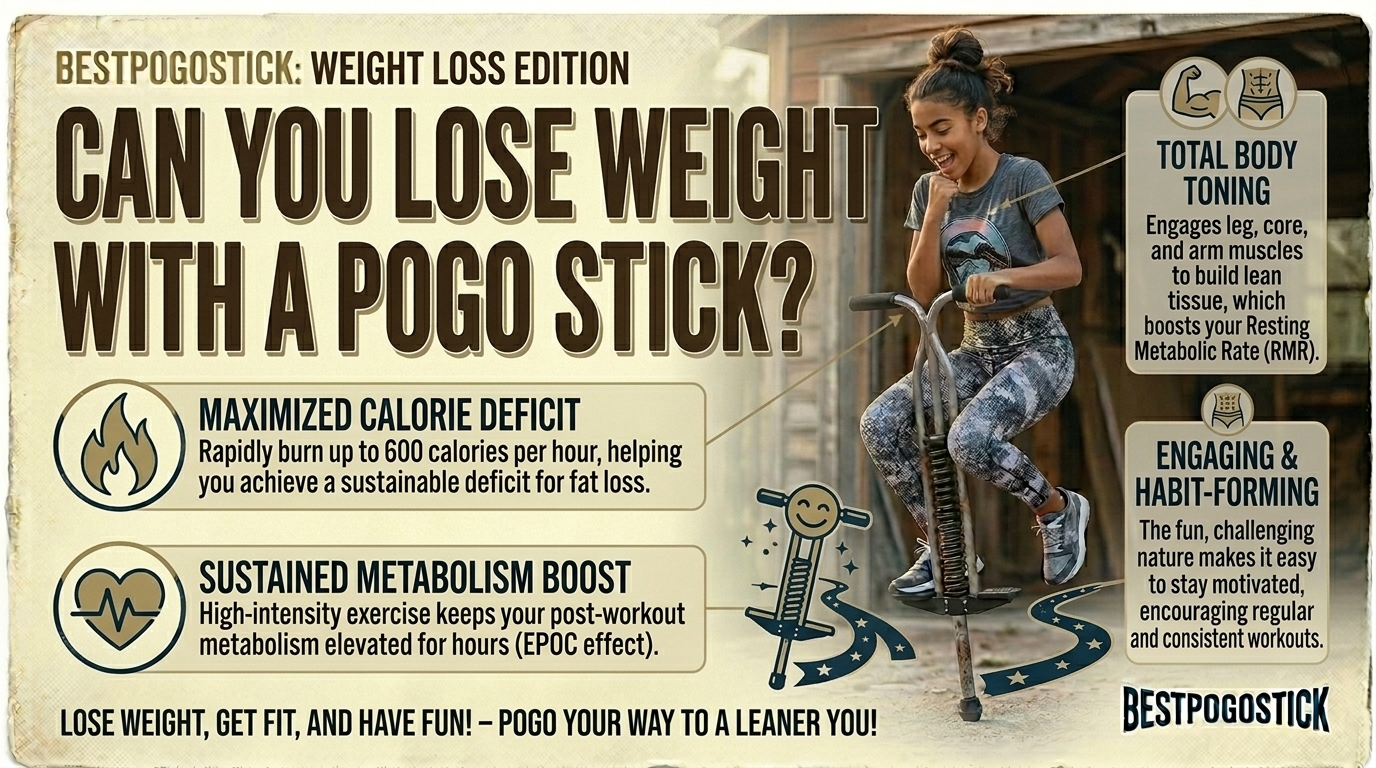
Can you lose weight with a pogo stick?
Can you lose weight with a pogo stick? The Ultimate Science, Caloric Math, and Core-Shredding Fitness Guide
If you have ever watched an extreme pogo athlete launch themselves ten feet into the air, or if you simply remember the classic spring-loaded toy from your childhood, you might have wondered: Is this just a playground game, or is it a hidden metabolic powerhouse?
When it comes to shedding stubborn body fat, we are conditioned to believe that we must endure long, boring hours on a treadmill or punish our joints with high-impact road running. But what if the most efficient, core-shredding cardiovascular workout in the world was actually fun, playful, and vertical?
At bestpogostick.com, we study human kinetics, vertical deceleration forces, and active calorie burning. In this comprehensive, scientifically grounded guide, we break down the clinical physics of vertical bouncing, calculate the exact metabolic math of jumping, and outline how you can turn a high-performance pogo stick into your ultimate weight-loss weapon.
                  ┌─────────────────────────────────────────┐
                  │    VERTICAL VS. HORIZONTAL EXPENDITURE  │
                  └─────────────────────────────────────────┘
                                       │
                  ┌────────────────────┴────────────────────┐
                  ▼                                         ▼
       ┌─────────────────────┐                   ┌─────────────────────┐
       │ HORIZONTAL RUNNING  │                   │  VERTICAL JUMPING   │
       │     (Forward)       │                   │   (Gravity-Defying) │
       └─────────────────────┘                   └─────────────────────┘
                  │                                         │
       • Linear mechanical work                  • Constant gravitational fight
       • Concentric quad dominance               • Continuous core stabilization
       • High joint shear forces                 • Eccentric deceleration loading
       • Moderate caloric density                • Massive metabolic demand
                                                            │
                                               ┌────────────┴────────────┐
                                               ▼                         ▼
                                    ┌─────────────────────┐   ┌─────────────────────┐
                                    │    Standard Spring  │   │  Air-Suspension     │
                                    │      Pogo (HIIT)    │   │  Extreme Pogo (V02) │
                                    └─────────────────────┘   └─────────────────────┘
1. The Quick Answer: What Google Searchers Need to Know Right Now
If you want the immediate, bottom-line truth: Yes, you can absolutely lose weight using a pogo stick. In fact, it is one of the most calorically dense, low-impact cardiovascular workouts available.
Jumping on a pogo stick is classified as a high-intensity, full-body plyometric exercise.
- The Caloric Density: An average adult weighing 180 lbs burns approximately 600 to 800 calories per hour of active pogo jumping. This matches or exceeds the caloric burn of high-velocity running, rowing, and competitive swimming.
- The Metabolic Secret: Unlike horizontal cardio (walking or running), vertical jumping forces your body to constantly fight gravity and decelerate its own body weight on every single bounce. This triggers massive activation in your deep core, glutes, hamstrings, and calves, keeping your metabolic rate elevated for hours after your workout ends (a physiological phenomenon known as EPOC, or Excess Post-Exercise Oxygen Consumption).
To turn a pogo stick into a highly efficient weight-loss engine, you must understand the underlying physical laws, muscle activation matrix, and structured weekly training variables.
2. The Biomechanics of Vertical Play: Can you lose weight with a pogo stick
To understand why pogo jumping is such an elite fat-burning tool, we have to look at the differences in how the human body expends energy when moving horizontally versus vertically.
The Physics of Constant Gravitational Fighting
When you run or cycle, your body uses its energy primarily to propel your mass forward. While you are working against wind resistance and friction, momentum assists your movement once you hit a steady state.
Vertical jumping, however, is a relentless battle against gravity. Every single bounce requires your muscles to:
- Explode (Concentric Phase): Push down against the pogo footpegs, compressing the spring or air chamber to launch your entire body weight into the air.
- Stabilize (Mid-Air Phase): Fire your deep abdominal muscles, obliques, and lower back to maintain perfect vertical alignment so you don’t tip over.
- Absorb & Decelerate (Eccentric Phase): Land safely, absorbing up to 2 to 3 times your body weight in gravitational forces, utilizing your calves, quads, and glutes to prepare for the next rebound.
This cyclic, explosive vertical deceleration is highly taxing on your metabolic systems, requiring massive amounts of oxygen and glucose to fuel the rapid muscle contractions.
3. The Caloric Math: Modeling Your Weight Loss Velocity
Weight loss is governed by the laws of thermodynamics. To oxidize (burn) one pound of body fat, you must create a cumulative deficit of approximately 3,500 calories.
Mathematically Modeling Vertical Work & Caloric Expenditure
To calculate the physical work ($W$) performed during a pogo session, we must look at body mass ($m$), gravitational acceleration ($g = 9.81 \, \text{m/s}^2$), average jump height ($h$), and the total number of jumps ($N$).$$W = m \cdot g \cdot h \cdot N$$
Because human skeletal muscle is only about $20\%$ to $25\%$ metabolically efficient ($\eta \approx 0.22$), the actual metabolic energy ($E_{\text{met}}$) expended by your body to perform this work is significantly higher:$$E_{\text{met}} = \frac{W}{\eta} = \frac{m \cdot g \cdot h \cdot N}{0.22}$$
Let’s model a real-world scenario for an individual weighing 180 lbs ($m \approx 81.6 \, \text{kg}$) jumping on a high-performance pogo stick (average bounce height $h = 0.45 \, \text{meters}$ or roughly 1.5 feet) at a steady cadence of $100 \, \text{jumps per minute}$ for a $20\text{-minute}$ session ($N = 2000 \, \text{jumps}$):$$W = 81.6 \times 9.81 \times 0.45 \times 2000 \approx 720,4248 \, \text{Joules}$$
Translating Joules to dietary kilocalories ($1 \, \text{kcal} = 4184 \, \text{Joules}$):$$E_{\text{mech}} = \frac{720,424.8}{4184} \approx 172.18 \, \text{kcal of mechanical work}$$
Applying the metabolic efficiency factor ($\eta = 0.22$):$$E_{\text{met}} = \frac{172.18}{0.22} \approx 782.6 \, \text{total calories burned per hour of activity}$$
Over a 30-day period, substituting just 20 minutes of daily pogo jumping into your routine yields a massive cumulative deficit:$$\text{Weekly Deficit} = 260.8 \, \text{kcal/session} \times 7 = 1,825.6 \, \text{kcal}$$$$\text{Monthly Deficit} = 1,825.6 \times 4.3 \approx 7,850 \, \text{kcal} \approx 2.24 \, \text{lbs of pure fat lost}$$
This calculation does not even include your baseline TDEE (Total Daily Energy Expenditure) or the massive metabolism-boosting effect of building dense lower-body muscle tissue.
4. Cardiovascular Intensity: Pogo vs. Traditional Exercises
How does the metabolic output of vertical bouncing stack up against traditional cardio options?
To illustrate, we have mapped out the metabolic equivalents (METs—the ratio of your active metabolic rate to your resting metabolic rate) across common exercises. A higher MET score translates directly to a faster, more time-efficient fat-burning session.
┌────────────────────────────────────────────────────────┐
│             CARDIO COMPARISON: MET VALUES Matrix       │
├───────────────────────────┬────────────────────────────┤
│ Pogo Bouncing (Extreme)   | 10.5 METs (Vigorous Plyo)  │
│ Jogging (5 mph)           | 8.3 METs (Moderate LISS)   │
│ Stationary Cycling (Mod)  | 7.0 METs (Steady State)    │
│ Walking (3.5 mph)         | 4.3 METs (Low Intensity)   │
└────────────────────────────────────────────────────────┘
| Exercise Type | Average MET Value | Calories Burned/Hour (150 lb Person) | Calories Burned/Hour (200 lb Person) | Main Metabolic System Used |
|---|---|---|---|---|
| High-Performance Pogo | 10.5 | 715 kcal | 950 kcal | Anaerobic/Aerobic (HIIT) |
| Running (6 mph) | 9.8 | 660 kcal | 880 kcal | Aerobic (Steady LISS) |
| Vigorous Rope Skipping | 11.0 | 750 kcal | 1000 kcal | Anaerobic/Sprinting |
| Moderate Swimming | 7.0 | 475 kcal | 630 kcal | Aerobic (Low Impact) |
| Brisk Walking (3.5 mph) | 4.3 | 290 kcal | 390 kcal | Aerobic (Active Recovery) |
Because pogo jumping combines the upper-body engagement of rowing with the lower-body explosiveness of rope skipping, it acts as a hybrid workout—delivering maximum caloric burn in half the time of standard running.
5. The Muscle Activation Matrix: Sculpting Your Body from the Ground Up
Losing weight is only half the battle of body recomposition; building dense, metabolically active lean muscle is what keeps the fat off permanently.
Unlike treadmill running, which primarily targets your hamstrings and quads in a limited plane of motion, pogo jumping requires a complete, multi-joint muscular contraction network to maintain equilibrium.
 ┌────────────────────────────────────────────────────────┐
 │           POGO JUMPING MUSCLE ENGAGEMENT MATRIX        │
 ├───────────────────────────┬────────────────────────────┤
 │ Core & Abdominals (90%)   | ████████████████████████   │
 │ Calves & Soleus (95%)     | █████████████████████████  │
 │ Glutes & Hamstrings (80%) | ████████████████████       │
 │ Quads & Hip Flexors (85%) | █████████████████████      │
 │ Upper Body & Shoulders(65%| ████████████████           │
 └────────────────────────────────────────────────────────┘
- The Deep Core (90% Activation): To keep the pogo stick perfectly vertical beneath you, your rectus abdominis, obliques, and transverse abdominis must lock in continuous, micro-isometric contractions. It is a non-stop standing plank that shreds your midsection.
- The Posterior Chain (80% Activation): Launching off the pegs requires massive drive from your gluteus maximus and hamstrings. This vertical extension lifts and tones your lower body far more effectively than traditional squats.
- The Calves & Tibialis (95% Activation): Your lower legs act as the primary kinetic shock absorbers, loading and releasing energy on every bounce. This rapid-fire plyometric loading builds lean, athletic calves and strengthens ankle joints.
- The Upper Body Stabilizers (65% Activation): Pulling up on the handlebars to control high-altitude bounces engages your forearms, biceps, deltoids, and lats, transforming pogoing into a true full-body kinetic workout.
6. Regional Blueprints: Conquering Vertical Weight Loss Across the US
Our kinetic coaches work with active communities across diverse geographic and cultural climates. Depending on where you live, environmental factors will dictate how you should structure your vertical weight-loss routine.
Texas: Beating the Heat and Bouncing Indoors
Across the hot, sprawling expanses of Texas, high summer temperatures can make outdoor cardio dangerous.
- The Challenge: High heat indexes, suburban concrete spaces, and lack of shaded recreational trails.
- The Strategy: Utilize high-performance spring-coil pogo sticks designed for indoor and garage use. Execute early morning sessions on shaded park basketball courts or covered driveways to maximize cool air flow.
- Kinetic Anchor: Combine short, high-intensity outdoor pogo intervals (10 minutes) with air-conditioned strength training inside your home gym to maximize your calorie deficit safely.
New York: Urban Rooftop Training and Concrete Shock Mitigation
In New York City and upstate urban grids, flat green space can be difficult to find.
- The Challenge: Hard concrete surfaces that increase joint impact, busy pedestrian traffic, and tight living spaces.
- The Strategy: Prioritize air-suspension pogo sticks (like the Flybar Super Pogo) which feature thick rubber tip dampers to absorb concrete shock. Use public spaces like Central Park, Hudson River parkways, or flat apartment rooftops for your training grounds.
- Kinetic Anchor: Focus on joint protection. Always jump on flat, stable asphalt or use a thick industrial rubber mat to absorb up to 30% of the kinetic impact away from your knees and shins.
California: Scenic Beachfront Bouncing and Mind-Body Integration
From the coastal paths of San Diego to the wellness communities of Los Angeles and San Francisco, California is perfectly suited for dynamic outdoor training.
- The Challenge: Balancing creative plyometrics with highly active, shared public spaces.
- The Strategy: Take advantage of smooth beach boardwalks, coastal concrete plazas, and ocean parkways. California dreamers respond incredibly well to gamified, vertical interval training.
- Kinetic Anchor: Sand-side bouncing. Placing an industrial jump mat directly on packed, wet sand offers the ultimate joint-friendly landing zone while requiring 1.5 times more core stabilization energy due to the slight shifting underfoot.
Washington: Damp Weather Bouncing and PNW Garage Workouts
In Washington state, managing constant mist, damp temperatures, and wet surfaces is a natural part of daily life.
- The Challenge: Slick, slippery outdoor surfaces that compromise traction and grip.
- The Strategy: Move your workouts indoors. Clear out your garage or utilize covered outdoor patios, public pavilions, and indoor sports complexes.
- Kinetic Anchor: Traction security. Always inspect the rubber bumper tip of your pogo stick for wetness before jumping, and choose shoes with deep, slip-resistant rubber soles to ensure your feet remain locked onto the footpegs during vertical ascents.
7. The Pogo Weight Loss & Caloric Burn Planner
To help you design the safest, most effective, and biologically supportive way to melt away body fat with a pogo stick, use our interactive planner below.
8. Safety & Joint Preservation: Is Pogoing Bad for Your Knees?
One of the most common myths surrounding pogo jumping is that it is destructive to your joints. It is easy to look at vertical bouncing and assume it carries the same high-impact wear-and-tear as running on hard pavement.
However, the physics of pogoing tell a completely different story.
The Spring-Coil Shock Absorption Loop
When you run, your foot strikes the concrete directly, sending an unmitigated shock wave up through your ankle, shin, knee, and lower back. This is known as high-shear impact.
When you jump on a high-quality pogo stick, your feet never actually touch the ground.
- The Spring Advantage: As you land, your downward kinetic energy is absorbed by a heavy-duty, industrial steel coil or a pressurized air-suspension system.
- 70% Impact Reduction: These mechanical shock systems absorb up to 70% of the downward deceleration force, translating the hard impact into a smooth, spring-loaded rebound.
- Eccentric Conditioning: Instead of joint-grinding shock, your muscles are forced to control a smooth, eccentric load. This builds bone density and strengthens the connective tissues around your knees, ankles, and hips—making it an excellent active-recovery companion to walking.
9. How to Build Your Pogo Weight Loss Routine (The 3-Tier Program)
To melt away body fat without burning out your nervous system, you must scale your intensity progressively. Use our clinical weight-loss training structure below:
Tier 1: The “Launchpad” Protocol (Beginner)
- The Goal: Build basic balance, ankle stability, and baseline cardiorespiratory capacity.
- The Routine: Perform 5 sets of 1 minute of continuous jumping. Rest 1 minute between sets.
- Frequency: 3 times per week.
- Estimated Caloric Burn: 100 – 120 kcal per session.
Tier 2: The “Bounce-Interval” Burner (Intermediate)
- The Goal: Target subcutaneous body fat through High-Intensity Interval Training (HIIT) to spark a 24-hour metabolic afterburn.
- The Routine: Jump vigorously for 2 minutes, immediately drop into a 1-minute walking recovery (no pogo), then repeat for 5 rounds (Total time: 15 minutes).
- Frequency: 4 times per week.
- Estimated Caloric Burn: 220 – 260 kcal per session.
Tier 3: The “Gravitational Shred” (Advanced)
- The Goal: Maximize cardiovascular $VO_2$ max, build raw core power, and shatter weight-loss plateaus.
- The Routine: 20 minutes of continuous, high-altitude jumping. Incorporate light vertical tricks (tucks, frame grabs, or twists) every 30 seconds to force rapid core stabilization.
- Frequency: 3 to 4 times per week.
- Estimated Caloric Burn: 350 – 450 kcal per session.
10. Master FAQ: Caloric Burn, Verticals, and Playful Fitness
1. Can you really lose weight using a pogo stick?
Yes, absolutely. Pogoing is an intense, full-body plyometric cardio workout. Because it engages your entire core, lower body, and upper body in constant stabilization against gravity, it burns calories at a rate equivalent to running or rope skipping—making it an exceptional tool for sustainable weight loss.
2. How many calories does 15 minutes of pogo sticking burn?
For an average adult weighing 180 lbs, a vigorous 15-minute pogo session burns approximately 150 to 200 calories. This number depends on your body weight, your jumping height, and the mechanical resistance of your pogo stick.
3. Is pogo jumping better than running for weight loss?
For many people, yes. While running burns a similar number of calories, it carries high-impact forces that can damage joints over time. High-performance pogo sticks rely on spring or air suspension systems that absorb up to 70% of the landing impact, making it a safer, lower-impact alternative to concrete jogging.
4. How long does it take to see weight loss results?
If you maintain a modest, balanced diet and incorporate 15 to 20 minutes of daily pogo jumping, you can expect to see healthy, sustainable weight loss of 1 to 2 pounds per week within the first month.
5. Can a pogo stick build abdominal abs?
Yes! To jump vertically without falling over, your deep core muscles (rectus abdominis, obliques, and lower back) must remain in constant, micro-isometric contraction. A 15-minute pogo session functions as a non-stop, dynamic standing plank, helping you sculpt a strong, defined midsection.
A Closing Word from bestpogostick.com Fitness should never feel like a chore. The biggest bottleneck to long-term weight loss is not a lack of willpower—it is boredom. When you dread your cardio routine, you are biologically wired to abandon it.
Step off the treadmill and into the air. Grab a high-performance pogo stick and turn your weight-loss journey into an exciting, high-flying, gravity-defying game. Walk to clear your mind, but jump to shock your metabolism, build functional core strength, and reclaim the playful, childlike joy of movement.